
Wildfire recovery in Altadena is about much more than just rebuilding homes. It’s a complex process filled with paperwork, stress, tight deadlines, and countless conversations that often start with, “So, what can we afford?” and too frequently end with, “I guess we can’t rebuild.” The emotional and financial toll on families is immense, making it crucial to explore all available options for a faster, more affordable recovery.
This is why I was delighted to meet with Gene Eidelman, CEO and co-founder of Azure Printed Homes, to ask the questions wildfire survivors in Altadena keep asking me, about timelines, real costs, permitting, fire resilience, and how families can avoid being displaced.
Here’s what stood out most from my conversation with Eidelman, and what I think Altadena residents should know before they sign anything.
Wildfire Recovery in Altadena: Stop Relying on a Parade of Contractors and Embrace Off-Site Construction
When I asked Eidelman to explain the real scope of what Azure does, he described it in a way that finally made sense. Instead of building everything out in the open, where you’re dependent on weather, daylight, and whether subcontractors show up, Azure builds most of the home inside a factory and then brings it to the site in modules.
Eidelman put it bluntly. “You’re not just buying a shell. These modules arrive with the major ‘inside the walls’ work already done: electrical, plumbing, insulation, and wall systems, so the on-site portion becomes shorter and more predictable.”
He emphasized that building in a controlled environment changes everything: builders can work two shifts, work weekends, aren’t delayed by rain, heat, or darkness, and because it’s happening at one location, homeowners can physically visit the factory and see progress at any time. This particularly matters in wildfire rebuild zones where families are exhausted and don’t have time to chase updates from ten different trades.
The biggest advantages, according to Eidelman, are supervision and consistency.
As a contractor, I’ve seen this firsthand: on traditional builds, one superintendent may be stretched across multiple projects, and you don’t always know what’s happening on your site day to day. Eidelman contrasted this with factory production. He described constant supervision, consistent processes, and the benefit of machine-precision manufacturing, “straight walls,” repeatable assembly, and fewer surprises. And he made another point that Altadena homeowners will appreciate: the timing of inspections.
In the field, you can lose days (or weeks) waiting for the inspection window. Eidelman explained that, in the modular home process, inspections can be coordinated more efficiently because work is done in one controlled place rather than waiting for an inspector to bounce between scattered sites.
Can they give you a firm price and a firm timeline?
I asked Eidelman the question I think matters most for families: deciding between a traditional rebuild, an ADU-first plan, or a modular/printed home. What’s the decision checklist? What should people verify before choosing a path? Eidelman’s answer again came back to two issues.
1) Can the contractor give you a firm price?
He noted that many traditional contractors struggle to commit to locked-in pricing because costs can change over a 12-month build due to issues with materials, tariffs, labor shortages, and subs not being available. In his view, the lack of price certainty is what is causing people to panic. He told me about a woman he met who lost a ~900 sq ft home and got a quote of around $650,000. Her response (and honestly, it’s a common one) was: “I can’t afford this.”
2) Can they give you a firm timeline (once you have permits)?
Eidelman acknowledged that permitting can be unpredictable, but said the bigger question is, once you have permits, how long until you’re done? Azure’s pitch is that by doing most of the work off-site and reducing the number of trades on the property, they can significantly shorten the on-site timeline. And he made a point I wish more survivors understood: If your rebuild takes longer, you pay more, not just in build cost, but in the real-life costs of displacement.
How to think about it responsibly.
Eidelman told me that when families compare their traditional quotes to modular housing proposals, he commonly sees about 30% savings. As someone writing for wildfire survivors, I want to be careful here: this is not a guarantee, because every property is different. But it’s still meaningful information, especially for families whose insurance proceeds won’t cover traditional rebuild bids.
What I appreciated most is that Eidelman doesn’t pretend every project has a simple one-size-fits-all price. He noted the variables around foundation, grading, utilities, permit requirements, soil and slope conditions, and, of course, finishes (because finishes can swing a budget fast).
‘Starting at’ isn’t the real number, so what should Altadena residents do?
I asked the blunt question: what does “starting at” really mean once you add site work, hookups, permits, delivery, customization—the things that always surprise people?
Eidelman pushed back on the concept of “hidden costs” and noted that Azure’s process is transparent. They outline up front what’s included and what’s optional. He also pointed out common add-ons, such as HVAC and solar, which vary from owner to owner. He also said something I think is fair and practical: You can’t find a universal formula in a blog article because the conditions vary by lot. But you can get to a fixed price quickly once the project is scoped. That’s the key takeaway.
What I’d recommend homeowners do next: When you get a quote, whether modular or traditional, ask for a written list of what’s included, a written list of what’s excluded, and a clear explanation of what could change the final total.
Fire resilience: ‘It’s not magic. It’s quality and closing the weak points.‘
When I asked Eidelman about wildfire resilience (because survivors are rebuilding with fear in the back of their minds), he said something that really stuck with me.
“Homes don’t survive because of luck. They survive because they were built well and hardened in the right places,” he said.
He described the common ways homes ignite:
- embers that break or breach windows
- embers pulled through vents/HVAC pathways
- embers landing on wooden roofs or wooden decks
- gaps and openings that allow embers to enter and ignite something inside
He also mentioned choices that go beyond minimum code requirements in high-risk areas, such as avoiding wood decks and being intentional about landscaping.
“It’s not just saving your house,” he said, “it’s saving your neighbor’s house,” which is the truth in a neighborhood like Altadena.
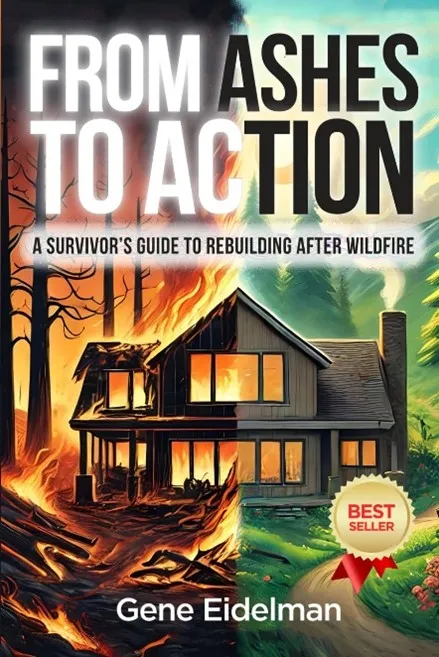
Eidelman also has written a book about this topic, based on what he observed after the Woolsey Fire and after years of rebuilding in fire zones, entitled From Ashes to Action, published by Staten House.
What Altadena needs to hear most: Rebuild as a neighborhood, not as isolated lots.
Altadena residents have been saying, loudly, “Altadena is not for sale.” People are scared that if rebuild costs stay out of reach, longtime families will be pushed out.
When I asked Eidelman about displacement and solutions, his answer was surprisingly community-based, strongly encouraging group rebuilding—neighbors coordinating projects—to reduce costs and chaos.
His reasoning was simple:
- Equipment mobilization is cheaper for two homes than for one
- Cheaper still for 10 or 20 homes
- Utilities and grading can be coordinated
- Schedules are cleaner
- The neighborhood doesn’t get clogged with uncoordinated subcontractor traffic for months
He described Malibu rebuild traffic after previous fires as a nightmare—streets clogged, no coordination, subs arriving whenever they could. His point: in large loss areas, coordination is not just cost-saving, it’s livability-saving as well.
Financing reality: speed lowers the financial bleeding.
When asked about financing, Eidelman said they’ve seen families use insurance proceeds where possible, SBA-related paths, and construction loans—especially because lenders understand rebuilds on owned land. But he also made an important financial point that isn’t often discussed. If your build finishes faster, your construction-loan interest carry can be lower. And if your insurance only covers rental housing for a limited time, delays can force families into the worst-case scenario – paying rent and a mortgage at the same time. Beyond stress, this is the factor that can financially break people.
My takeaway for Altadena wildfire survivors
Here’s what I learned after hearing Eidelman answer the following questions.
Suppose you are presented with a traditional rebuild quote that doesn’t align with your insurance proceeds and doesn’t include a firm timeline. In that case, you owe it to yourself to explore modular/off-site options – including companies like Azure – before you decide you can’t rebuild. Not because modular is “magic.” But because predictability matters right now, which encompasses a predictable schedule, predictable inspection flow, fewer trades on site, clearer scope, and potentially meaningful cost savings, depending on your property and design choices.
The questions to bring to any rebuild meeting (print and save)
If you’re a wildfire survivor in Altadena, bring these questions to every contractor or modular provider.
- What is the total timeline after permits are in hand?
- Can you give a firm price, and what could change it?
- What exactly is included vs excluded (HVAC, solar, appliances, delivery, foundation, permits)?
- What’s your fire-hardening plan (windows, vents, decking, roof approach, defensible space guidance)?
- What can be coordinated with neighbors to save money (grading, utilities, scheduling)?
If you get clear answers to these five questions, you’ll be ahead of most people—and you’ll be making decisions from strength instead of from fear.